This is a ready-to-print page
Design states, omnipresence, and the agentic future
This article explores how our familiar interaction states may be evolving into something more ambient, adaptive, and almost alive. What once behaved like static interface conditions increasingly feels more like a living system: responsive, self-regulating, and capable of sensing or anticipating near-future scenarios.
Traditionally, interface states such as default, focus, hover, disabled, pressed, and active belonged to a bounded world of screens, windows, and direct user action. But in an age of ubiquitous computing, distributed identities, and agentic systems, interaction is no longer contained in one place or one moment. This article is an exploration of that shift.
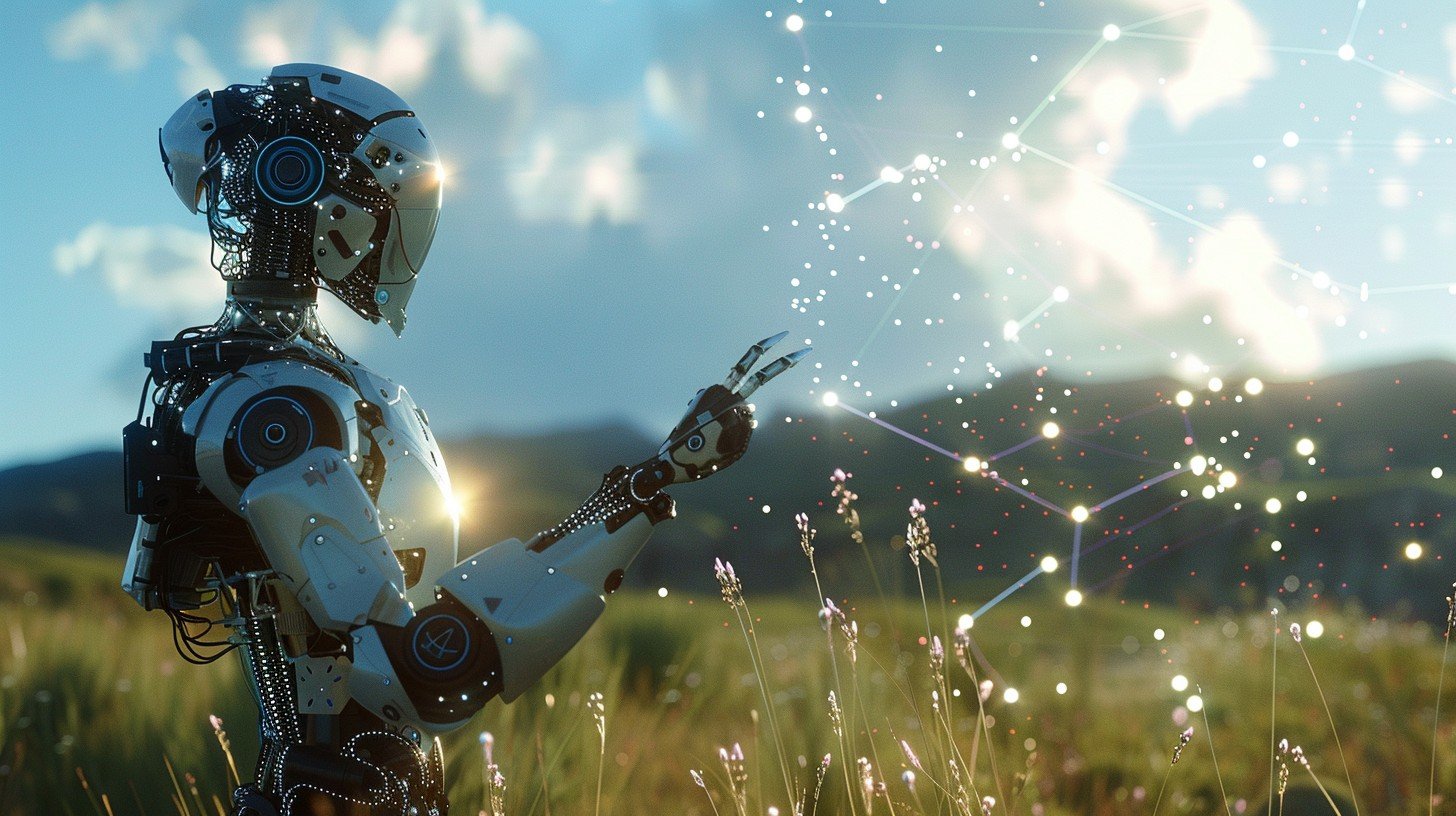
Photo by Stockcake
The challenge
The challenge is that the classic six interaction states were designed for a very different computational world. They emerged from Human– Computer Interaction and GUI design systems, especially the lineage of WIMP interfaces: Windows, Icons, Menus, and Pointer. They reflect a local, bounded interaction loop in which a user acts on a discrete element in a clearly defined context.
That model assumes the user is present and focused on a single interface, that the system is reactive rather than proactive, and that time flows in discrete input-and-response cycles. In a ubiquitous or ambient computing world, those assumptions begin to collapse. The interface is no longer only a screen. The user is no longer bounded to one device or context. And the system is no longer passive. It has continuity, memory, and a degree of agency.
This means interaction can no longer be understood only as a momentary state change on a button or control. It becomes an ongoing negotiation between distributed human and machine agents across time, space, and context.
My role
My role in this piece is to reframe interaction design through a more expansive lens. I am interested in how traditional UI concepts can be extended into a language that better reflects ambient systems, asynchronous presence, and agentic futures.
Rather than discarding the existing interaction states, I am looking at how they might evolve into broader relationship conditions. These are no longer just input states, but states of awareness, intention, delegation, and continuity. In this sense, design begins to move from rendering interfaces to shaping living fields of relation.
Process and approach
The process begins with the classic six interaction states: default, focus, hover, disabled, pressed, and active.
The default state is the initial landing condition, before direct interaction. Focus appears when a user intentionally engages, often by keyboard navigation or selection. Hover signals possible interaction through proximity. Disabled communicates temporary dormancy. Pressed captures the threshold between contact and release. Active represents a persistent selection or acknowledgment.
These states are useful, but in the agentic age they may need to be expanded into meta-states that express continuity rather than isolated events.
Toward new states in the agentic age
| New state | Description |
|---|---|
| Ambient | The system and user are mutually aware but not in active interaction. Context is sensed, but no direct engagement is occurring. |
| Anticipatory | The system predicts or infers potential intent and subtly prepares responses before explicit interaction happens. |
| Delegated | The user has handed partial or full control to an agent. Interaction becomes asynchronous, ambient, or representational. |
| Reconciled | The system merges asynchronous actions, data, and context into a coherent whole after interaction. |
| Trans-temporal | The interaction is not bounded by the present moment. It reflects continuity across time and context, such as an agent acting in your absence, remembering, or adapting. |
These states recognise that interaction is continuous, distributed, and temporally fuzzy. If we also question linear time as the only way to understand interaction, then traditional UI states begin to look like simplified snapshots rather than the full picture.
A view of time and relation
If time is partly a construct of local perception, then states such as hover or pressed only make sense inside a linear event model: event, response, next event. But in an agentic temporal framework, interaction becomes nonlinear. Actions ripple across moments, presence can be asynchronous yet immediate, and intention can persist beyond direct contact.
Instead of states as frames in time, we might think in terms of fields of relation: multidimensional conditions of attention, intention, agency, and contextual gravity that coexist and overlap.
A new ontology of interaction
In this view, interaction may be modelled less as a timeline and more as an energy field or network of presences. Each agent, human or synthetic, occupies a vector within that field, expressing:
- Attention: degree of focus or awareness
- Intention: goal or purpose projection
- Agency: capacity to act autonomously
- Contextual gravity: how strongly an environment attracts or modulates behaviour
The states of interaction then become dynamic configurations of these vectors rather than a simple sequence of inputs and outputs.
From industrial roots to conscious systems
These ideas also sit within a larger historical movement. Interaction states emerged from industrial and cybernetic worldviews shaped by standardisation, control, and predictable feedback. Over time, design moved from mechanical precision to adaptive interaction. Today it is moving again, toward agentic systems that sense, anticipate, and learn.
In that transformation, consciousness starts to appear almost like a new user state: awareness itself becoming an interactive modality. The interface is no longer static. It becomes responsive, ecological, and anticipatory.
Design systems as living organisms
Modern design systems increasingly behave less like static toolkits and more like living organisms. They sense, adapt, and maintain coherence across changing environments.
- Antigens – unexpected inputs or contextual changes
- Antibodies – adaptive responses via AI or design logic
- Homeostasis – maintaining brand, trust, and ethical balance
- Evolution – continuous learning from interaction data
SLDS 2 and design evolution
Salesforce Lightning Design System 2 reflects part of this wider transition. Its use of CSS custom properties, its preference for resilient base Lightning components over custom blueprints, and its AI-ready architectural direction suggest a move toward consistency, adaptability, and systems prepared for more intelligent forms of interaction.
My contribution
My contribution in this article is to connect interaction design, systems thinking, cybernetics, biomimicry, and posthuman design into a single evolving perspective. I am interested in design not as a fixed set of interface rules, but as a conscious and adaptive process that responds to changing relationships between humans, machines, and environments.
This perspective sees design systems not just as collections of components, but as living frameworks capable of sensing, reconciling, and adapting across contexts. It also suggests that future design work will rely more on shaping conditions of awareness, presence, and agency than on defining static moments of interaction alone.
Recommended reading and resources
Industrial and mechanistic origins
- Frederick Winslow Taylor – The Principles of Scientific Management (1911)
- Henry Ford – My Life and Work (1922)
- Lewis Mumford – Technics and Civilization (1934)
Cybernetics and systems thinking
- Norbert Wiener – Cybernetics (1948)
- Ross Ashby – An Introduction to Cybernetics (1956)
- Stafford Beer – Brain of the Firm (1972)
- Heinz von Foerster – Understanding Understanding (2003)
Human–Computer Interaction
- Donald Norman – The Design of Everyday Things (1988 / 2013)
- Bill Buxton – Sketching User Experiences (2007)
- Lucy Suchman – Plans and Situated Actions (1987)
- Terry Winograd & Fernando Flores – Understanding Computers and Cognition (1986)
Living systems and biomimicry
- Humberto Maturana & Francisco Varela – Autopoiesis and Cognition (1980)
- Fritjof Capra – The Web of Life (1996)
- John Holland – Complex Adaptive Systems (1992)
- Janine Benyus – Biomimicry: Innovation Inspired by Nature (1997)
Anticipation, agency, and futures
- Mihai Nadin – Anticipation (2015)
- Riel Miller – Transforming the Future (UNESCO, 2018)
- Benjamin Bratton – The Stack (2016)
- Elisa Giaccardi – Design for the Posthuman Era (2021)
Consciousness, ethics, and posthumanism
- Alfred North Whitehead – Process and Reality (1929)
- Francisco Varela – Ethical Know-How (1999)
- Donna Haraway – A Cyborg Manifesto (1985)
- Andy Clark – Supersizing the Mind (2008)
- Karen Barad – Meeting the Universe Halfway (2007)
Contemporary extensions
- Neri Oxman – Material Ecology (2020)
- Ezio Manzini – Design, When Everybody Designs (2015)
- Arturo Escobar – Designs for the Pluriverse (2018)
Salesforce and accessibility resources
- Accessibility (WCAG 2.0)
- Design Guidelines Overview
- Salesforce Blueprint Overview
- Design Tokens
- Voice and Tone
- Accessibility Overview
This reading path offers a panoramic foundation, from industrial standardisation to posthuman, agentic views of design systems as living, anticipatory organisms prepared for the AI age.